Summary
COURSE PROJECT · CHALMERS
PUBLIC INSTALLATION
URBAN INTERACTION
TANGIBLE INTERACTION
2026
The Public Editor
Three street installations that turn passersby into the newsroom of Harry Hjörnes Plats.

ROLE
Interaction Designer
TIMELINE
Exhibited May 2026
PLATFORM
Physical installations + VR installation + Web pages
TEAM member
Hang Wan, Jiliang Ye, Qiqi Zhu
STAKEHOLDERS
Vasakronan
Harry Hjörnes Plats is named after one of Gothenburg’s most important newspaper editors, yet almost nobody who walks through it knows why. How can a busy square reconnect with its forgotten story without blocking the people passing through?
Concept · Station design · Exhibition prototype · Observation study
A working prototype of three stations and a live front page, shown at a public exhibition at FUSE. Visitors found the physical buttons more real than a touchscreen, and the central screen made the collective process easy to understand.
Watch video
See the system
The system
Three stations, one front page. Each station is one step of making a newspaper, placed at a street entrance around the square.
STEP 01
Walk past a station
Each one works on its own, with no app and no order to follow.
STEP 02
Make one quick action
Take a photo, hear an interview, or write a few lines.
STEP 03
See it on the front page
Your contribution appears on the screen in the square in real time.
STEP 04
Start over at midnight
The page is blank every morning: a new newspaper every day.

A
The News Camera
A 1950s–60s news camera with a real shutter button. Pick one of today’s topics and its headline appears over the live view. Step into the photo spot, press the shutter, and the photo goes to CITIZEN LENS, where a nine-panel wall lets people vote for the Best News of the Day.
B
The Interview Recorder
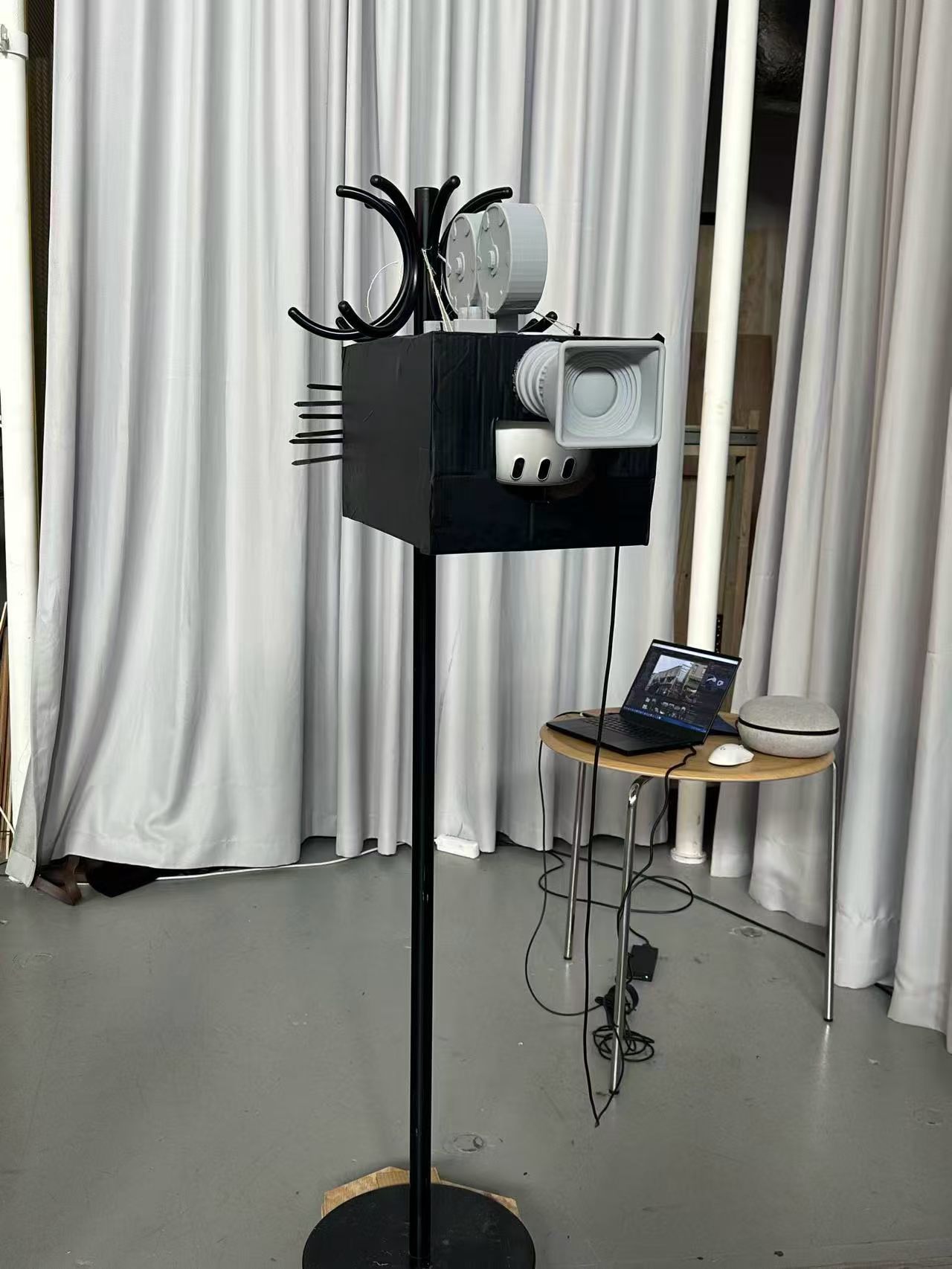
A 1970s TV camera on a tripod with a VR headset hidden in the viewfinder. Look into Gothenburg at different times in history; hold your gaze on a historical figure and the interview begins, unlocking them in TODAY’S LEGENDARY VISITORS. A frosted-glass enclosure facing a wall corner keeps it visible but private.


C
The Editor’s Typewriter
A vintage editor’s desk with a real typewriter. Read the day’s news fragments, write a short text and press the big PUBLISH button. It is matched to an editorial paragraph and published in EVERYONE EDITS, echoing Harry Hjörne’s own column of small everyday observations.
SCREEN
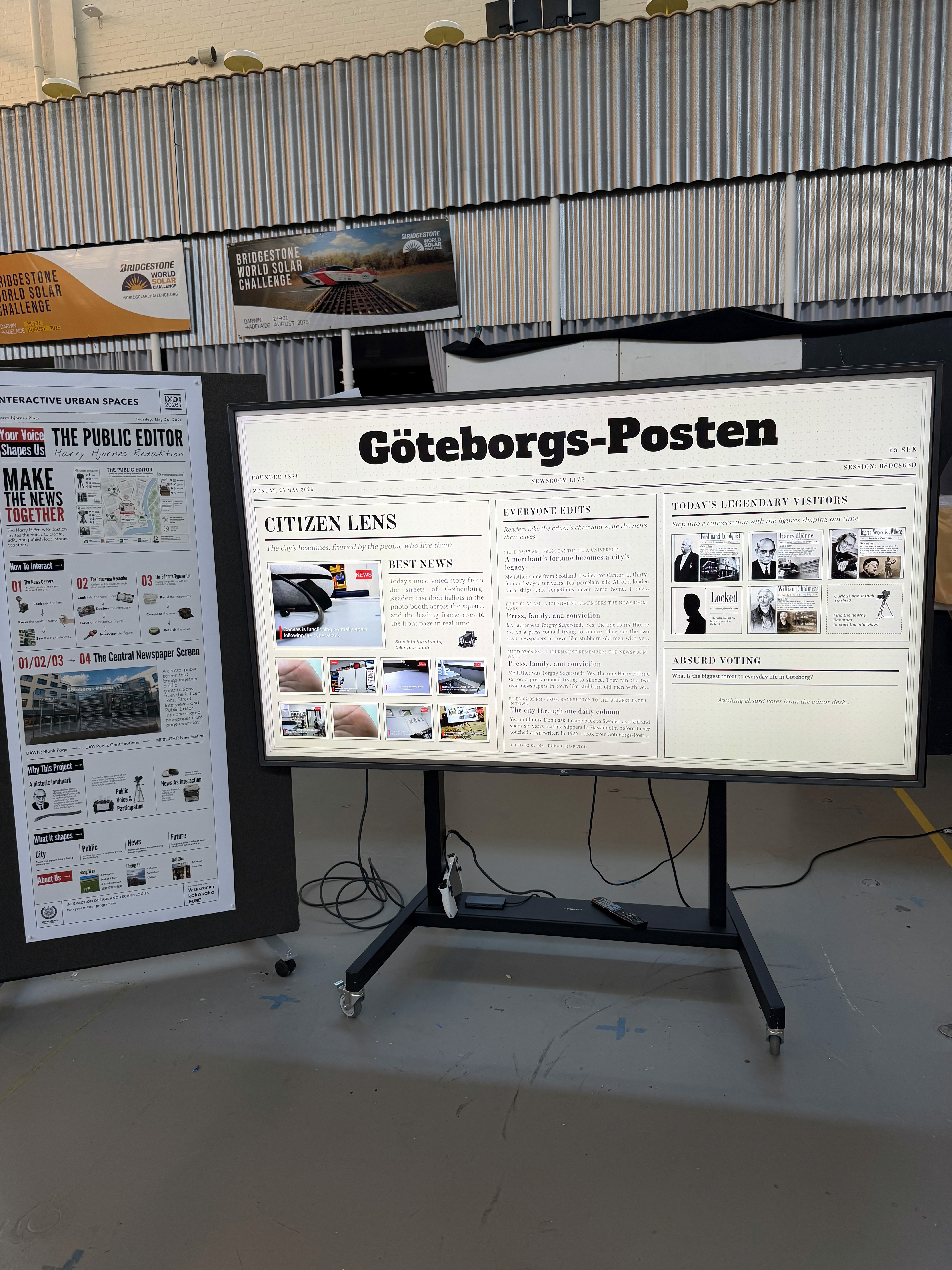
The central front page
A transparent screen on the stone memorial shows the day’s front page in four sections: CITIZEN LENS, EVERYONE EDITS, TODAY’S LEGENDARY VISITORS and ABSURD VOTING, a light-hearted question that keeps the page from feeling too serious.
Site & context
A square that forgot its name
Harry Hjörne turned Göteborgs-Posten into one of the city’s largest newspapers and wrote a much-loved column of small everyday observations. The square was named after him, but today nothing there tells his story: the name on the ground is the only trace most people ever see.
“Who decides what a city should see?”
The question the project started from. In a newspaper, editors decide. Here, everyone passing by does.
SITE ANALYSIS
01
A crowded centre where nobody stops
Thousands pass the central memorial every day, but almost no one stays more than a few seconds.
02
Street entrances invite a pause
The entrances from Kyrkogatan, Drottninggatan and Stora Nygatan are calmer and offer natural moments to rest.
03
Dark, damaged, waiting for renewal
Poor lighting at night, broken paving and no seating, with a city renovation planned but not started.
DESIGN PRINCIPLES
01
Under a minute, in any order
Every station works on its own and can be finished in less than a minute.
02
No personal device
No app, phone or login. Walk up, act, and see the result.
03
Structured content
What each station collects stays consistent without anyone moderating it.
04
The square only displays
Participation happens at the edges, keeping the busiest area clear.
Related work
Exhibition study
FUSE EXHIBITION
OBSERVATION
SHORT INTERVIEWS
SUPERVISOR FEEDBACK
Three prototype stations were spread around the exhibition hall with the front page in the middle, recreating the distributed layout of the square. The study was informal and qualitative, so the findings are indicative rather than conclusive.
Prototype stations at the FUSE exhibition
Pressing the shutter and the large PUBLISH button, with the click of the camera and the sound of the typewriter, felt more real than a touchscreen. The moment of submission became a clear, real action.
Visitors understood the whole system once they saw photos, texts and votes come together into one newspaper page. The screen is not just an output; it makes the collective process visible.
This confirmed the frosted-glass enclosure for the Interview Recorder. It also exposed a harder problem: the News Camera can capture bystanders behind a participant.
Visitors and supervisors asked for a mix of serious and light topics, and interviews that build a story across days.
Tensions & limitations
Topics are set by us, editorials come from a pre-written library and the headline photo is chosen by vote. This keeps content coherent and safe, but blurs who the editor is. We aimed for a working balance between open participation and curation rather than resolving it.
The Interview Recorder’s enclosure protects passersby by design rather than by signs or agreements, but it was only shown as a render, and it does not cover the News Camera’s public photos.
The Interview Recorder is screen-based, takes longer than a minute and isolates the user from the street. We kept it for its historical immersion, but the inconsistency is real.
Sunlight on the transparent screen, rain and wind, pedestrian flow at the entrances and long-term maintenance still need to be tested in the actual square.
Reflection
The square becomes a newsroom every day.
The Public Editor started with one question: who gets to decide what a city sees? Here, everyone passing by takes part. They press the shutter, look into the viewfinder and press PUBLISH, and those small actions come together into the day’s front page, which resets at midnight and begins again the next morning.
NEXT STEPS
A larger news library that balances serious and light-hearted topics
Tiered unlocks and random events so regular passersby discover new historical figures
Connecting the citizens’ front page to the real Göteborgs-Posten
Applying the same approach to other places that have lost touch with their history
Team project with Hang Wan and Jiliang Ye · Supervisor: Aris Alissandrakis · Chalmers University of Technology